
WG 4 – Objectives
Chromatic aberration refers to possible artifacts caused by the wavelength dependency of an imaging system’s optical properties, with the result that two colors arising from the same physical location within the sample appear separated in the image. Such artifacts result from the optical design of the system (e.g., well-corrected versus poorly corrected objective lenses), the manufacturing tolerances of the system components, and the alignment of the optical components.
Co-registration accuracy more generally refers to the system’s ability to co-localize dyes of different wavelengths emitting from the same object within a particular experimental set-up. This can be affected by both the experimental set-up and the system architecture. Working within the assumption that microscope users are ultimately interested in co-registration accuracy, WG4 aims to use sub-resolution and larger multi-colored bead preparations to measure co-registration accuracy. Alternative tools for performing these measurements will also be evaluated. WG4 will compare reproducibility across different laboratories to determine the best protocol.
WG 4 – Co-Chairs
Call:
+351 226 074 900
Email:
maria.azevedo@i3s.up.pt
Maria Azevedo
Co-Chair of WG 4 and WG 15


Call:
+33 156246565
Email:
aurelien.dauphin@curie.fr
Aurelien Dauphin


Call:
+1 (514) 352-8547
Email:
jlacoste@miacellavie.com
Judith Lacoste

WG 4 - Latest News
 Hans Fried1, Roland Nitschke2, Kees van der Oord3, Maria M. Azevedo4,5
1. CRFS – Light Microscope Facility, German Center for Neurodegenerative Diseases (DZNE), Bonn, Germany
2. Life Imaging Center and Signalling Research Centre CIBSS, University of Freiburg, Germany
3. Nikon Europe BV, Amstelveen, Netherlands
4. Advanced Light Microscopy Scientific Platform, i3S – Instituto de Investigação e Inovação em Saúde | Porto, Portugal
5. University of Porto
Accurate multi‑colour imaging requires that signals from the same physical location co‑localise across channels. Chromatic aberration is a major source of spatial error in multi‑colour fluorescence microscopy. Therefore, rigorous co‑registration is essential for reliable interpretation of spatial relationships in biological specimens.
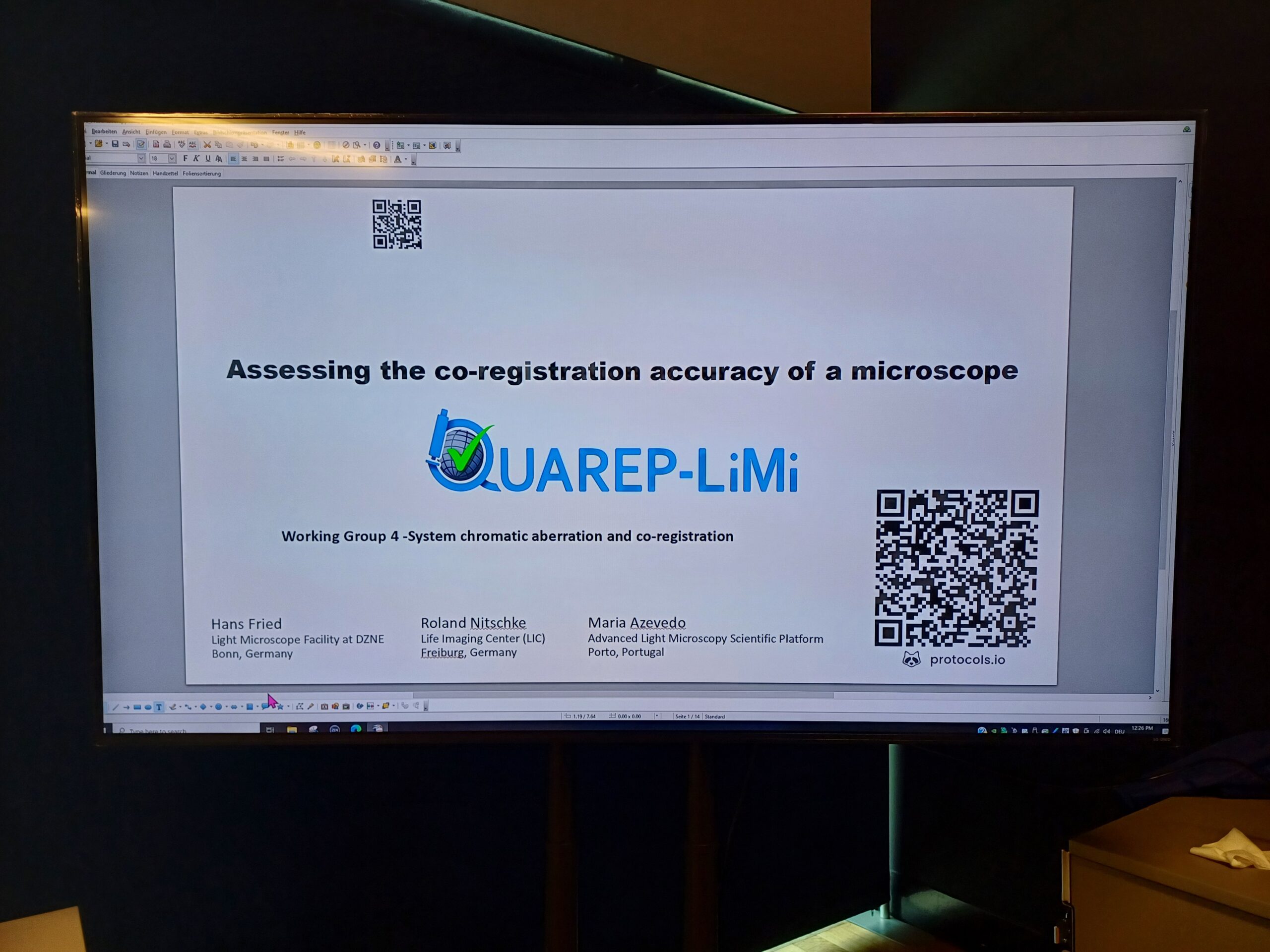
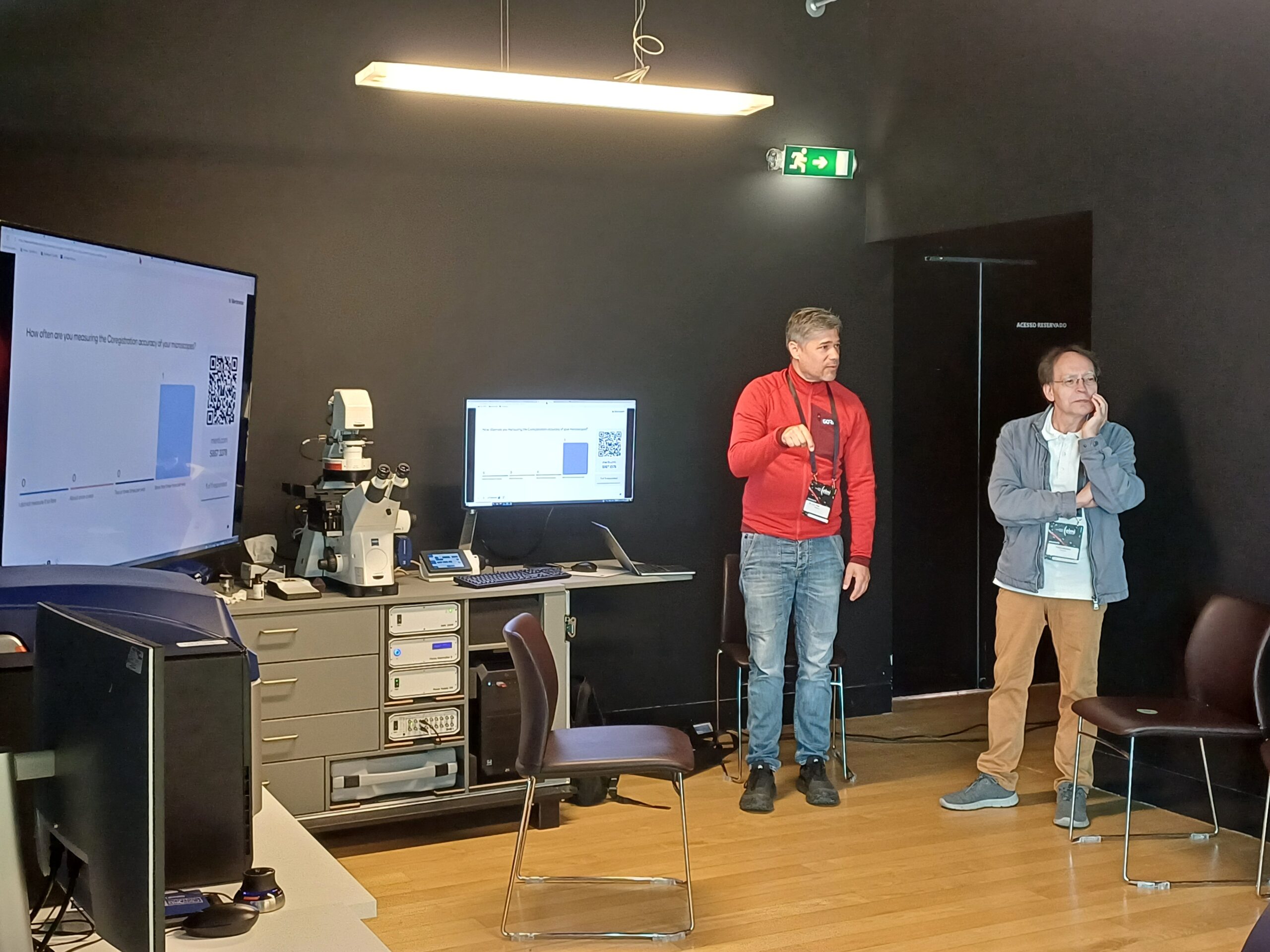
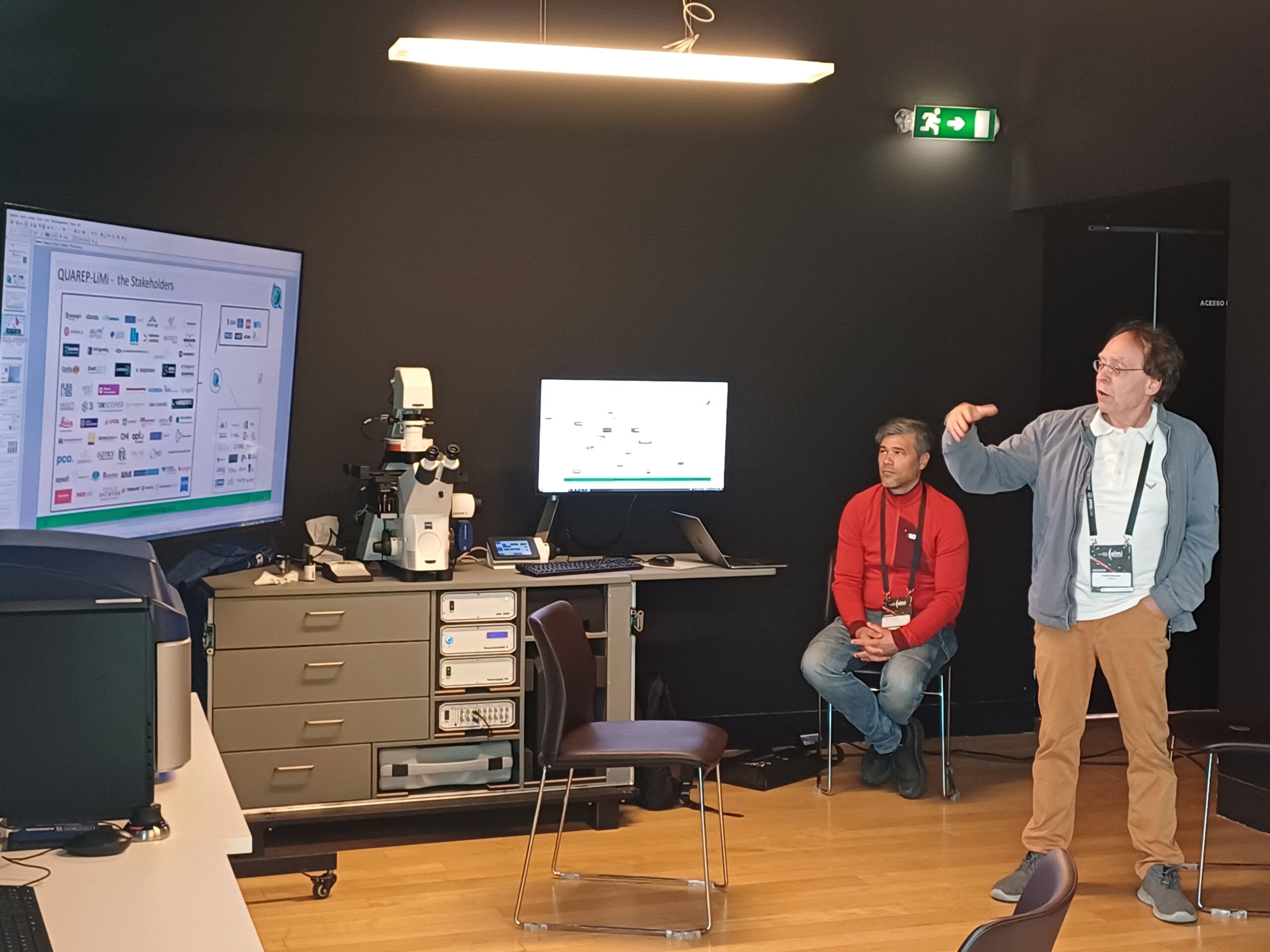
In this workshop, we will briefly explain the key steps of preparing a bead sample for co-registration assessment, show the main considerations for image acquisition (1), and show you how to analyze the obtained images using Fiji/ImageJ (2). We will also demonstrate how specific objective‑related factors can influence co‑registration performance. Finally, we will share practical hints and tips to support routine co‑registration analysis.
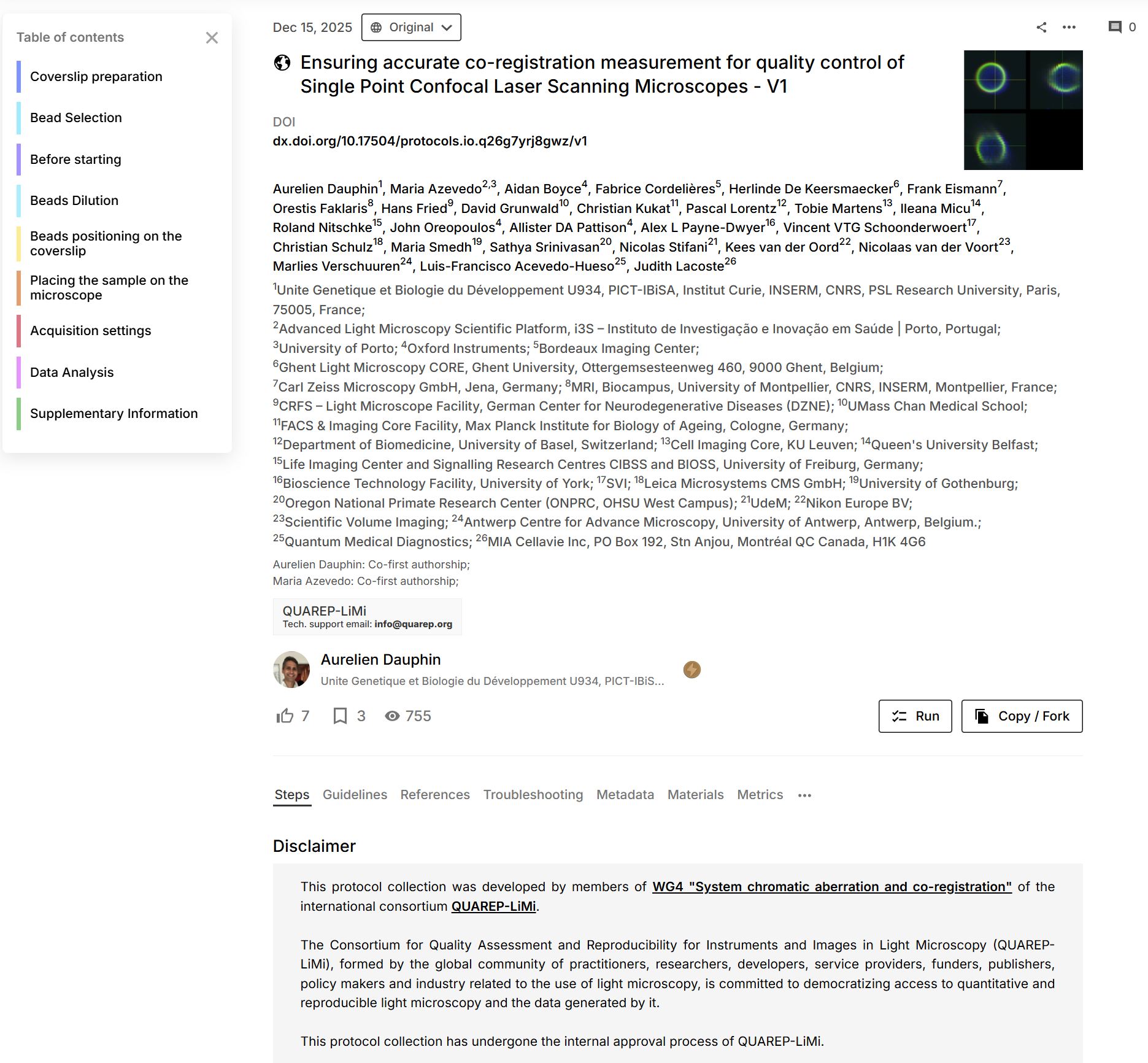
(1) Dauphin A., Azevedo, M., et al. Protocols.io, Ensuring accurate co-registration measurement for quality control of Single Point Confocal Laser Scanning Microscopes – V1, dx.doi.org/10.17504/protocols.io.q26g7yrj8gwz/v1
(2) Faklaris, O. et al. Quality assessment in light microscopy for routine use through simple tools and robust metrics. J Cell Biol 221, doi:10.1083/jcb.202107093 (2022).
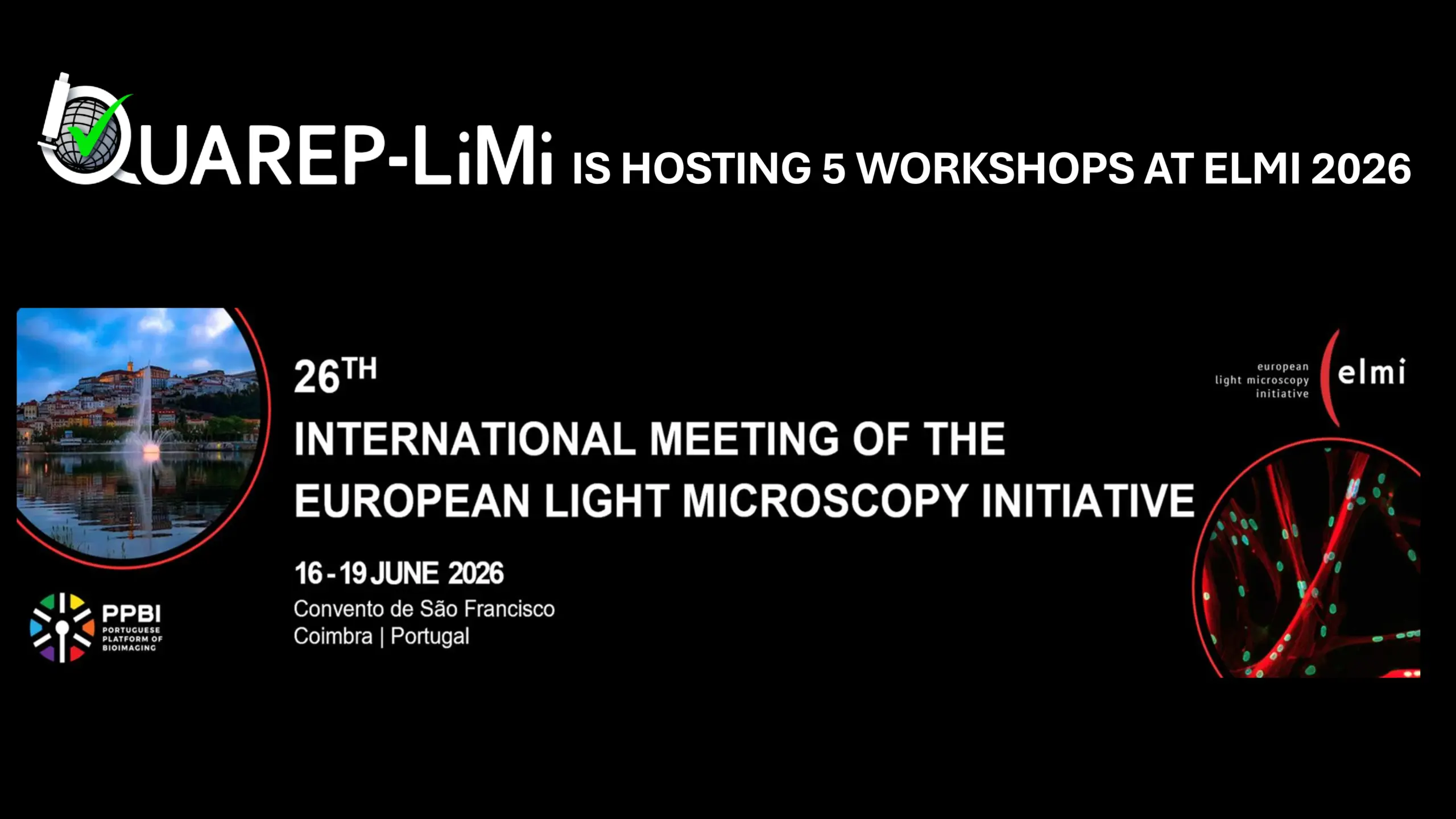
We are pleased to announce that the QUAREP-LiMi consortium will be presenting five specialized workshops at the upcoming European Light Microscopy Institute (ELMI) meeting. Our sessions are designed to provide researchers with frameworks for improving image quality, ensuring data reproducibility, and implementing rigorous quality control standards in microscopy. The workshops will cover five critical pillars of instrument characterization:
-
The QUAREP-LiMi Tool Kit (WGs 1 & 2):
Discover how to streamline periodic quality assessments. We will present the latest developments in the Tool Kit, including user-friendly software tools for illumination power and stability (compatible with Nikon and Zeiss), as well as its data browser for long-term performance monitoring. -
Detector Performance & Photon Characterization (WG2):
Learn how to transition from "arbitrary digital units" (ADU) to actual photon counts using the Photon Transfer Curve (PTC) method. We will demonstrate protocols for characterizing photon conversion factors, read noise, and dynamic range for both point and area detectors. -
Assessing the co-registration accuracy of a microscope (WG4):
Chromatic aberration is a major source of spatial error in multi‑colour fluorescence microscopy. This workshop will show practical hints and tips to perform routine co‑registration measurement and analysis. -
Point Spread Function (PSF) Analysis (WG5):
This workshop provides a practical guide to PSF measurement—from beads slide preparation and image acquisition to analysis using open-source tools and integration with OMERO for longitudinal monitoring. -
The Light-Microscopy Metadata Model (LiMi-Model, WG7):
In collaboration with BioImaging North America, 4D Nucleome, and OME, we will introduce the LiMi-Model. This framework aims to harmonize the description of hardware and acquisition settings to ensure datasets are FAIR (Findable, Accessible, Interoperable, and Reusable) by design.

We warmly welcome our first member from Nigeria, Dr Olubunmi Ayobami Balogun, from the University of Ibadan who just joined Working Group 1, 4 and 12.
Last meeting: 21st April 2026, 5:00 pm
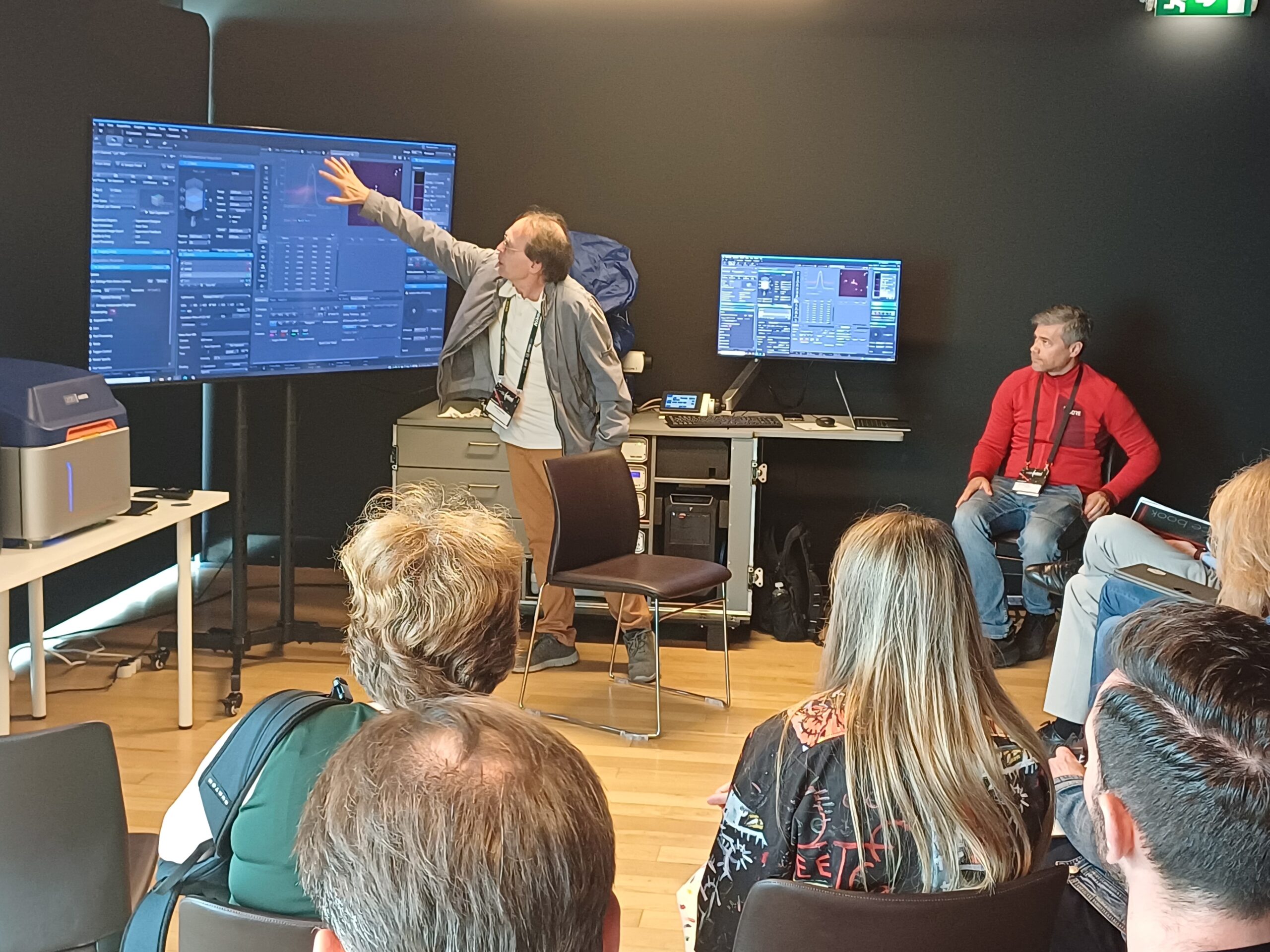

54th meeting, 21st of April 2026
Meeting date
Meeting summary
53rd meeting, 17th of March 2026
Meeting date
Meeting summary
52nd meeting, 17th of February 2026
Meeting date
Meeting summary
49th meeting, 16th of September 2025
Meeting date
Meeting summary
48th meeting, 17h of June 2025
Meeting date
Meeting summary
46th meeting, 15th of April 2025
Meeting date
Meeting summary
Memberlist WG 4
Last name First Name Town Organisation Affiliation Lab Affiliation Country Time Zone
Acevedo
Luis
Overland Park
thya
Industry
US
UTC-6
Ahmadpour
Noushin
Winnipeg
University of Manitoba
Univ.
CA
UTC-5
Aleksandrova
Nataliia
Freiburg im Breisgau
UNI Freiburg
Univ.
DE
UTC+1
Alshafie
Walaa
Ashburn
Janelia research campus
Univ.
US
UTC-4
Avilov
Sergiy
Freiburg
Max Planck Institute of Immunobiology and Epigenetics
MPG
DE
UTC+2
Azevedo
Maria
Porto
i3S/University of Porto
Univ.
PT
UTC+1
Badrodien
Imraan
West Haven
Yale University
Univ.
US
UTC-4
Bagley
Steve
Manchester
University of Manch.
Univ.
GB
UTC+1
Balogun
Olubunmi
Ibadan
University of Ibadan
Univ.
NG
UTC+1
Banerjee
Priyam
New York
Rockefeller University
Univ.
US
UTC-5
Barachati
Fábio
Berlin
PicoQuant GmbH
Industry
DE
UTC+1
Bosch
Manel
Barcelona
University of Barcelona CCITUB
Univ.
ES
UTC+2
Boyce
Aidan
Cours-de-Monségur
Oxford Inst. Andor
Industry
FR
UTC+1
Broeking
Kai
Goettingen
MPI
MPG
DE
UTC+2
Brunt
Peter
Fairport
AVR Optics
Industry
US
UTC-5
Carvalho
Mariana
Braga
INL – International Iberian Nanotechnology Laboratory
EU-Org
PT
UTC+-0
Casse
Alhassan
Vitry-sur-Seine
SANOFI
Industry
FR
UTC+2
Chacko
Jenu
Madison
University of Wisconsin-Madison
Univ.
US
UTC-6
Chatterjee
Nabanita
Gothenburg
University of Gothenburg
Univ.
SE
UTC+1
Cole
Louise
Sydney
University of Technology
Univ.
AU
UTC+11
Corbett
Alex
Exeter
UK BioImaging
Univ.
GB
UTC+1
Cordelières
Fabrice
Bordeaux
University of Bordeaux
Univ.
FR
UTC+2
Cortes
Luisa
Coimbra
Center for Neuroscience and Cell Biology
Univ.
PT
UTC+0
Cresens
Charlotte
Leuven
VIB
Univ.
BE
UTC+2
Dauphin
Aurelien
Paris
RTmfm
Univ.
FR
UTC+2
De Keersmaecker
Herlinde
Ghent
UGent
Univ.
BE
UTC+1
Dencevski
Aleksa
Belgrade
Institute of physics Belgrade
Univ.
CS
UTC+1
Diez-Guerra
F. Javier
Madrid
CBMSO (CSIC-UAM)
Univ.
ES
UTC+2
Doherty
Glen
New York
Icahn School of Medicine at Mount Sinai
Univ.
US
UTC-4
Duong
Cao Nguyen
Saarbrücken
Leibniz Institute for New Materials
Leibniz
DE
UTC+1
Duwé
Sam
Diepenbeek
Universiteit Hasselt
Univ.
BE
UTC+1
Ecker
Rupert
Vienna
TissueGnostics GmbH
Univ.
AT
UTC+1
Eismann
Frank
Jena
Carl Zeiss Microscopy GmbH
Industry
DE
UTC+2
Eseola
Alice
Norwich
The Sainsbury Laboratory
Univ.
GB
UTC+1
Esner
Milan
Brno
Ceitec Masaryk University
Univ.
CZ
UTC+1
Fallet
Mathieu
Marseille
CNRS
Univ.
FR
UTC+1
Forbes
Ashli
Vancouver
University of British Columbia
Univ.
CA
UTC-8
Fried
Hans
Bonn
GerBi-GMB WG 1
Helmholtz
DE
UTC+2
Geißler
Daniel
Berlin
PolyAn GmbH
Industry
DE
UTC+1
Gheisari
Ali
Bergkirchen
Thorlabs GmbH
Industry
DE
UTC+2
Giakoumakis
Nikolaos
Barcelona
Institute for Research in Biomedicine Barcelona
Univ.
ES
UTC+1
Goda
Kazuhito
Hachioji
EVIDENT
Industry
JP
UTC+9
Greenwood
Harrison
London
The Francis Crick Institute
Univ.
GB
UTC+-0
Grunwald
David
Worcester
University of Massachusetts
Univ.
US
UTC-4
Guiot
Elvire
Illkirch
IGBMC
Univ.
FR
UTC+2
Halidi
Nadia
Barcelona
Centre for Genomic Regulation
Gov.
ES
UTC+2
Hao
Xiang
Hangzhou
Zhejiang University
Univ.
CN
UTC+8
Harizanova
Jana
Copenhagen
CFIM/University of Copenhagen
Univ.
DK
UTC+1
Hassani
Ibrahim
Amsterdam
Nikon BV
Industry
NL
UTC+2
Hatto
Mao
Prague
Nikon
Industry
CZ
UTC+2
Inavalli
V V G
Southampton
University of Southampton
Univ.
GB
UTC+-0
Jiang
Junqing
London
National Physical Laboratory
Gov.
GB
UTC+-0
Jost
Aurélie
Jena
Friedrich Schiller University Jena
Univ.
DE
UTC+1
Kaiping
Arnica
Freiburg
University of Freiburg
Univ.
DE
UTC+2
Kirchenbüchler
David
Chicago
Northwestern
Univ.
US
UTC-6
Köning
Rainer
Braunschweig
PTB Braunschweig
Gov.
DE
UTC+1
Krens
Gabriel
Klosterneuburg
Institute of Science and Technology Austria
Gov.
AT
UTC+1
Krzic
Uros
Munich
Carl Zeiss Microscopy GmbH
Industry
DE
UTC+2
Kukat
Christian
Cologne
GerBi-GMB WG 1
MPG
DE
UTC+2
Lacoste
Judith
Montreal
MIA Cellavie Inc.
Industry
CA
UTC-4
Lagerholm
Christoffer
Oxford
University of Oxford
Univ.
GB
UTC+1
Lai
Pok Yui
Oxford
University of Oxford
Univ.
GB
UTC+1
Lai
Queenie
London
The Institute of Cancer Research
Univ.
GB
UTC+-0
Laktiushkin
Viktor
Sochi
Sirius
Univ.
RU
UTC+3
Landua
Kalika
Houston
Nikon Instruments
Industry
US
UTC-5
Le Bihan
Melvin
Hilversum
SVI
Industry
NL
UTC+1
Leavesley
Silas
Mobile
University of South Alabama
Univ.
US
UTC-5
Lees
Robert
Didcot
Science and Technology Facilities Council
Gov.
GB
UTC+-0
Levitt
James
London
Nikon Imaging Centre, King’s College London, UK
Univ.
GB
UTC+-0
Li
Xiaoming
Shanghaitech
Shanghaitech University
Univ.
CN
UTC+8
Liu
Tristan
New York
Columbia University
Univ.
US
UTC-4
Lorentz
Pascal
Basel
Department of Biomedicine University of Basel
Univ.
CH
UTC+2
Louis
Boris
Leuven
KU Leuven
Univ.
BE
UTC+1
Mahou
Pierre
Palaiseau
Laboratory for Optics and Biosciences, Ecole Polytechnique
Univ.
FR
UTC+1
Manning
Lane
Fairport
AVR Optics
Industry
US
UTC-5
Martens
Tobie
Leuven
Cell Imaging Core KU Leuven
Univ.
BE
UTC+1
Mast
Fred
Seattle
Seattle Children’s Hospital
Univ.
US
UTC+8
Micu
Ileana
Belfast
Queen’s University Belfast
Univ.
GB
UTC+1
Monterroso
Baptiste
Nice
University of Nice
Univ.
FR
UTC+2
Naidoo
Viantha
Cape Town
University of Cape Town
Univ.
ZA
UTC+2
Nechyporuk-Zloy
Volodymyr
London
Imperial College of Science, Technology and Medicine
Univ.
GB
UTC+-0
Nitschke
Roland
Freiburg
University of Freiburg, Life Imaging Center
Univ.
DE
UTC+2
Oord
Kees
Amsterdam
Nikon
Industry
NL
UTC+1
Parel
Emma
Cape Town
University of Cape Town
Univ.
ZA
UTC+2
Pattison
Allister
Belfast
Andor
Industry
GB
UTC+-0
Payne-Dwyer
Alex
York
University of York
Univ.
GB
UTC+-0
Peron-Cane
Caroline
PARIS
TELIGHT
Industry
FR
UTC+1
Pihan
German
Boston
BIDMC/HARVARD
Univ.
US
UTC+5
Politi
Antonio
Göttingen
Max Planck Institute of Biophysical Chemistry
MPG
DE
UTC+1
Pospíšil
Jakub
Dresden
QUAREP-LiMi / Technische Universität Dresden
Univ.
DE
UTC+1
Rezgui
Rachid
Abu Dhabi
NYU Abu Dhabi
Univ.
AE
UTC+4
Saeed
Mezida
Edgabaston
University of Birmingham
Univ.
GB
UTC+-0
Saint-Hilaire
Cadisha
Paris
Curie Institute
Univ.
FR
UTC+1
Schapman
Damien
Rouen
Normandy University
Univ.
FR
UTC+2
Schmied
Jürgen
Gräfelfing
GATTAquant GmbH
Industry
DE
UTC+2
Schreiner
Ryan
New York
Weill Cornell Medicine
Univ.
US
UTC-4
Schulz
Christian
Wetzlar
Leica DIN/ISO
Industry
DE
UTC+2
Segal
Gabriela
Melbourne
University of Melbourne
Univ.
AU
UTC+10
Selbach
Florian
Gräfelfing
GATTAquant GmbH
Industry
DE
UTC+2
Shakouri
Mahsa
Heidelberg
DKFZ
Industry
DE
UTC+12
Shemesh
Michal
Delft
TUD
Univ.
NL
UTC+1
Silván Alcaraz
Ágata
Copenhagen
University of Copenhagen
Univ.
DK
UTC+1
Smith
Carlas
Delft
Delft University of technology
Univ.
NL
UTC+2
Sporbert
Anje
Berlin
GerBi-GMB WG 1
Helmholtz
DE
UTC+2
Srinivasan
Sathya
Beaverton
ONPRC
Univ.
US
UTC-8
Stifani
Nicolas
Montréal
Université de Montréal
Univ.
CA
UTC-5
Tapia
Pablo
Bethesda
National Institutes of Health (NIH)
Gov.
US
UTC-4
Tesa
Maria
Livingston
Edinburgh Instruments
Industry
GB
UTC+-0
Thomson
Darren
Exeter
University of Exeter
Univ.
GB
UTC+1
Thuenauer
Roland
Hamburg
Heinrich Pette Institute
Leibniz
DE
UTC+2
van der Voort
Hans
Hilversum
Scientific Volume Imaging BV
Industry
NL
UTC+1
Verschuuren
Marlies
Antwerp
University of Antwerp
Univ.
BE
UTC+2
Voort
Nicolaas
Hilversum
Scientific Volume Imaging BV
Industry
NL
UTC+2
Wee
Erika
Cold Spring Harbor
Cold Spring Harbor Laboratory
Univ.
US
UTC-5
Yao
Jie
Seattle
Allen Institute
Private lab
US
UTC-7
Zhou
Chunyuan
Pudong New Area
Nikon Instruments (Shanghai) Co.,Ltd
Industry
CN
UTC+8
Zhu
Chengxi
Cambridge
University of Cambridge
Univ.
GB
UTC+-0