
WG 3 – Objectives
Illumination field uniformity is critical for quantitative imaging when comparing fluorescence intensities across a field-of-view (FOV) or a large tile of images capturing an entire sample. If the illumination is not constant over a large area, the fluorescence intensities will not represent the inherent fluorescence but rather the location within the image. Thus, WG3 aims at defining a set of universal protocols to assess the uniformity of illumination (i.e., “flatness” of field) over the FOV of any photon-based imaging system and allow for correction of any non-uniformity. These protocols will identify the necessary tools, the procedures required to perform the measurements, and the analysis methods required for their interpretation. WG3 will also define criteria regarding the cut-off for acceptability and the need for correction. A database will be created with ideal images of uniform fields-of-view from different microscope modalities and settings to be used as a reference by the community and validate the protocol and criteria.
WG 3 – Co-Chairs

Call:
+49 89 8578 3971
Email:
spitaler@biochem.mpg.de
Martin Spitaler


WG 3 - Latest News
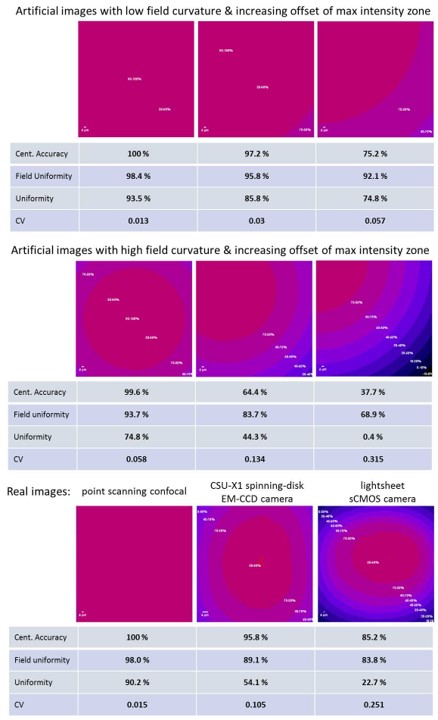
New QUAREP-LiMi Protocol: Monitoring Field Homogeneity
Working Group 3 (Field Homogeneity) is pleased to share a new open-access protocol: "Monitoring Field Homogeneity", authored by colleagues from institutions across Europe, Canada, and beyond.
Field homogeneity — the uniformity of illumination and detection across the field of view — is a cornerstone of quantitative fluorescence imaging. Changes in field homogeneity over time can be an early warning sign of problems in the optical path, such as misaligned light sources, a dirty or damaged objective, or aging light guides.
This protocol offers a straightforward, low-cost approach to measuring field homogeneity and tracking it over time, using widely available fluorescent sample materials. It covers recommended standard samples, sample preparation, QC image acquisition, quantification using the free MetroloJ QC Fiji plugin, and recommended testing frequency — and is broadly applicable across objective types and magnifications.
Importantly, this protocol is designed to monitor consistency on a single instrument over time, rather than for direct benchmarking across different microscopes.
Read the full protocol

QUAREP-LiMi WG3 was pleased to host a webinar presented by Daniel Schröder on the topic of the "Universal Laser Engine" with an improved homogeneous illumination profile.
The webinar introduced a versatile laser excitation platform designed for advanced fluorescence microscopy and highlighted its applications across multiple imaging modalities.
Abstract
The Universal Laser Engine is a user-friendly laserbox designed to provide a versatile excitation for advanced fluorescence microscopy. In a single box, it holds up to 6 laser wavelengths operating in modes ranging from picosecond-pulsed to continuous-wave, enabling its use across a wide range of imaging modalities. The Universal Laser Engine has been successfully tested in widefield microscopy, super-resolution localization microscopy, total internal reflection fluorescence (TIRF), and fluorescence lifetime imaging microscopy (FLIM). In addition, the Universal Laser Engine incorporates a novel speckle-suppression technology that generates a highly homogeneous flat-top hat profile that is applicable for high-speed imaging at exposure times down to microseconds. The system provides various trigger inputs and two fiber outputs for seamless integration into both existing and new microscopes. By combining flexibility, compact design, and state-of-the-art illumination uniformity, the Universal Laser Engine offers a powerful and adaptable solution for simplifying and modernizing fluorescence microscopy instrumentation.
We welcome a new member to our working groups 2, 3, 10, 11 and 12. Mr. Aleš Kladnik from, the Biotechnical Faculty of University of Ljubljana in Slovenia just joined QUAREP-LiMi.
Last meeting: 12th March 2026, 5:00 pm

Memberlist WG 3
Last name First Name Town Organisation Affiliation Lab Affiliation Country Time Zone
Aleksandrova
Nataliia
Freiburg im Breisgau
UNI Freiburg
Univ.
DE
UTC+1
Alshafie
Walaa
Ashburn
Janelia research campus
Univ.
US
UTC-4
Avilov
Sergiy
Freiburg
Max Planck Institute of Immunobiology and Epigenetics
MPG
DE
UTC+2
Azevedo
Maria
Porto
i3S/University of Porto
Univ.
PT
UTC+1
Bagley
Steve
Manchester
University of Manch.
Univ.
GB
UTC+1
Banerjee
Priyam
New York
Rockefeller University
Univ.
US
UTC-5
Bosch
Manel
Barcelona
University of Barcelona CCITUB
Univ.
ES
UTC+2
Bourg
Nicolas
Cachan
Abbelight
Industry
FR
UTC+1
Braunstein
Thomas
København N
Kbh. Uni. CFIM
Univ.
DK
UTC-1
Broeking
Kai
Goettingen
MPI
MPG
DE
UTC+2
Brunt
Peter
Fairport
AVR Optics
Industry
US
UTC-5
Burke
Russell
Beaverton
Lumencor
Industry
US
UTC-8
Campbell
George
Memphis
St. Jude Children’s Research Hospital
Private lab
US
UTC-6
Carvalho
Mariana
Braga
INL – International Iberian Nanotechnology Laboratory
EU-Org
PT
UTC+-0
Catrina
Irina
New York
Yeshiva University
Univ.
US
UTC-5
Ceccarelli
Raino
Rome
CrestOptics S.p.A.
Industry
IT
UTC+1
Chacko
Jenu
Madison
University of Wisconsin-Madison
Univ.
US
UTC-6
Cialowicz
Katarzyna
New York
Icahn School of Medicine at Mount Sinai
Univ.
US
UTC-5
Clément
Jean-Emmanuel
Villeneuve d’Ascq cedex
University of lille
Univ.
FR
UTC+2
Cole
Louise
Sydney
University of Technology
Univ.
AU
UTC+11
Cole
Richard
Albany
New York State Dept of Health, Wadsworth Center
Gov.
US
UTC-7
Dauphin
Aurelien
Paris
RTmfm
Univ.
FR
UTC+2
Dencevski
Aleksa
Belgrade
Institute of physics Belgrade
Univ.
CS
UTC+1
Diez-Guerra
F. Javier
Madrid
CBMSO (CSIC-UAM)
Univ.
ES
UTC+2
Duwé
Sam
Diepenbeek
Universiteit Hasselt
Univ.
BE
UTC+1
Ecker
Rupert
Vienna
TissueGnostics GmbH
Univ.
AT
UTC+1
Eseola
Alice
Norwich
The Sainsbury Laboratory
Univ.
GB
UTC+1
Esner
Milan
Brno
Ceitec Masaryk University
Univ.
CZ
UTC+1
Fasoli
Anna
Davis
89 North
Industry
US
UTC-8
Ferdous
Zannatul
Sapporo
Hokkaido University
Univ.
JP
UTC+9
Fujimori
Toshihiko
Okazaki
JP BioImaging
Gov.
JP
UTC+9
Geißler
Daniel
Berlin
PolyAn GmbH
Industry
DE
UTC+1
Girard
Philippe
Paris
Institut Jacques Monod – Université de Paris
Univ.
FR
UTC+1
Goda
Kazuhito
Hachioji
EVIDENT
Industry
JP
UTC+9
Gramann
Alex
Andover
CoolLED Ltd.
Industry
GB
UTC+-0
Greenwood
Harrison
London
The Francis Crick Institute
Univ.
GB
UTC+-0
Grunwald
David
Worcester
University of Massachusetts
Univ.
US
UTC-4
Gudavicius
Dominykas
Vilnius
Light Conversion
Industry
LT
UTC+2
Hannan
Riley
Charlottesville
University of Virginia
Univ.
US
UTC-5
Hassani
Ibrahim
Amsterdam
Nikon BV
Industry
NL
UTC+2
Hatto
Mao
Prague
Nikon
Industry
CZ
UTC+2
Herzog
Dylan
London
Microscopy Innovation Centre, King’s College London
Univ.
GB
UTC+-0
Ho
Kenneth
London
The Francis Crick Institute
Private lab
GB
UTC+-0
Inavalli
V V G
Southampton
University of Southampton
Univ.
GB
UTC+-0
Joyal
Mathieu
Ottawa
University of Ottawa
Univ.
CA
UTC-4
Kaiping
Arnica
Freiburg
University of Freiburg
Univ.
DE
UTC+2
Key
Jillian
Ottawa
University of Ottawa
Univ.
CA
UTC-4
Kirchenbüchler
David
Chicago
Northwestern
Univ.
US
UTC-6
Kladnik
Aleš
Ljubljana
University of Ljubljana, Biotechnical Faculty
Univ.
SI
UTC+1
Köning
Rainer
Braunschweig
PTB Braunschweig
Gov.
DE
UTC+1
Krzic
Uros
Munich
Carl Zeiss Microscopy GmbH
Industry
DE
UTC+2
Kumar
Purnima
CAMBRIDGE
Gurdon Institute, University of Cambridge
Univ.
GB
UTC+-0
Lahlou
Aliénor
PARIS
Sony CSL – Paris
Univ.
FR
UTC+1
Lai
Pok Yui
Oxford
University of Oxford
Univ.
GB
UTC+1
Lai
Queenie
London
The Institute of Cancer Research
Univ.
GB
UTC+-0
Laktiushkin
Viktor
Sochi
Sirius
Univ.
RU
UTC+3
Landua
Kalika
Houston
Nikon Instruments
Industry
US
UTC-5
Lee
Kitty
Stanford
Stanford University
Univ.
US
UTC-8
Lee
Woei Ming Steve
Canberra
John Curtin School of Medical Research, The Australian National University
Univ.
AU
UTC+10
Levitt
James
London
Nikon Imaging Centre, King’s College London, UK
Univ.
GB
UTC+-0
Li
Xiaoming
Shanghaitech
Shanghaitech University
Univ.
CN
UTC+8
Liu
Tristan
New York
Columbia University
Univ.
US
UTC-4
Lorentz
Pascal
Basel
Department of Biomedicine University of Basel
Univ.
CH
UTC+2
Louis
Boris
Leuven
KU Leuven
Univ.
BE
UTC+1
Manning
Lane
Fairport
AVR Optics
Industry
US
UTC-5
Mast
Fred
Seattle
Seattle Children’s Hospital
Univ.
US
UTC+8
Micu
Ileana
Belfast
Queen’s University Belfast
Univ.
GB
UTC+1
Monterroso
Baptiste
Nice
University of Nice
Univ.
FR
UTC+2
Mulholland
Jonathan
Stanford
Stanford University
Univ.
US
UTC-7
Munck
Sebastian
Leuven
University of Leuven
Univ.
BE
UTC+2
Narvaez
William
Lastenia Toral
NGSI
Private lab
EC
UTC-5
Nechyporuk-Zloy
Volodymyr
London
Imperial College of Science, Technology and Medicine
Univ.
GB
UTC+-0
Nitschke
Roland
Freiburg
University of Freiburg, Life Imaging Center
Univ.
DE
UTC+2
Oord
Kees
Amsterdam
Nikon
Industry
NL
UTC+1
Oreopoulos
John
Toronto
Oxford Inst. Andor
Industry
CA
UTC-5
Orlova
Natalia
Seattle
Allen Institute
Private lab
US
UTC-7
Oster
Markus
Munich
MPI of Biochemistry
MPG
DE
UTC+2
Parel
Emma
Cape Town
University of Cape Town
Univ.
ZA
UTC+2
Pattison
Allister
Belfast
Andor
Industry
GB
UTC+-0
Peng
Tingying
Neuherberg
Helmholtz Munich
Helmholtz
DE
UTC+1
Perin
Paola
Pavia
University of Pavia
Univ.
IT
UTC+1
Peterka
Darcy
New York
Columbia University
Univ.
US
UTC+5
Petrov
Maxim
Yekaterinburg
SIAMS Ltd
Industry
RU
UTC+5
Pospíšil
Jakub
Dresden
QUAREP-LiMi / Technische Universität Dresden
Univ.
DE
UTC+1
Quansah
Elsie
La Jolla
Salk Institute
Private lab
US
UTC-7
Reither
Sabine
Basel
Friedrich Miescher Institute for Biomedical Research
Private lab
CH
UTC+2
Rexhepaj
Elton
Paris
Sanofi
Industry
FR
UTC+1
Ritz
Sandra
Mainz
Institute of Molecular Biology – IMB
Univ.
DE
UTC+2
Saint-Hilaire
Cadisha
Paris
Curie Institute
Univ.
FR
UTC+1
Sanetrnik
Vojtech
Brno
Telight
Industry
CZ
UTC+1
Sathappan
Abbirami
Doha
Sidra Medicine
Gov.
QA
UTC+3
Sauer
Ryan
Williston
89 North, Inc.
Industry
US
UTC-4
Schapman
Damien
Rouen
Normandy University
Univ.
FR
UTC+2
Schmied
Jürgen
Gräfelfing
GATTAquant GmbH
Industry
DE
UTC+2
Schreiner
Ryan
New York
Weill Cornell Medicine
Univ.
US
UTC-4
Schuchardt
Chris
Jena
Carl Zeiss Jena GmbH
Industry
DE
UTC+1
Segal
Gabriela
Melbourne
University of Melbourne
Univ.
AU
UTC+10
Selbach
Florian
Gräfelfing
GATTAquant GmbH
Industry
DE
UTC+2
Shakouri
Mahsa
Heidelberg
DKFZ
Industry
DE
UTC+12
Shemesh
Michal
Delft
TUD
Univ.
NL
UTC+1
Silván Alcaraz
Ágata
Copenhagen
University of Copenhagen
Univ.
DK
UTC+1
Simm
Alan
Liverpool
Liverpool John Moores University
Univ.
GB
UTC+-0
Spitaler
Martin
Munich
MPI of Biochemistry
MPG
DE
UTC+2
Srinivasan
Sathya
Beaverton
ONPRC
Univ.
US
UTC-8
Stifani
Nicolas
Montréal
Université de Montréal
Univ.
CA
UTC-5
Tapia
Pablo
Bethesda
National Institutes of Health (NIH)
Gov.
US
UTC-4
Thomson
Darren
Exeter
University of Exeter
Univ.
GB
UTC+1
Thuenauer
Roland
Hamburg
Heinrich Pette Institute
Leibniz
DE
UTC+2
Titus
Steve
Rising SUn
ThermoFisher
Industry
US
UTC-5
Tu
Haohua
Urbana
University of Illinois at Urbana-Champaign
Univ.
US
UTC-6
Valiya Peedikakkal
Liyana
Oxford
Oxford Nanoimaging
Industry
GB
UTC+1
van der Voort
Hans
Hilversum
Scientific Volume Imaging BV
Industry
NL
UTC+1
van Oostende-Triplet
Chloë
Ottawa
University of Ottawa
Univ.
CA
UTC-5
Wee
Erika
Cold Spring Harbor
Cold Spring Harbor Laboratory
Univ.
US
UTC-5
Węgierski
Tomasz
Warsaw
International Institute of Molecular and Cell Biology
Gov.
PL
UTC+2
Wilde
Geraint
Belfast
Oxford Inst. Andor
Industry
GB
UTC+1
Zhou
Chunyuan
Pudong New Area
Nikon Instruments (Shanghai) Co.,Ltd
Industry
CN
UTC+8