
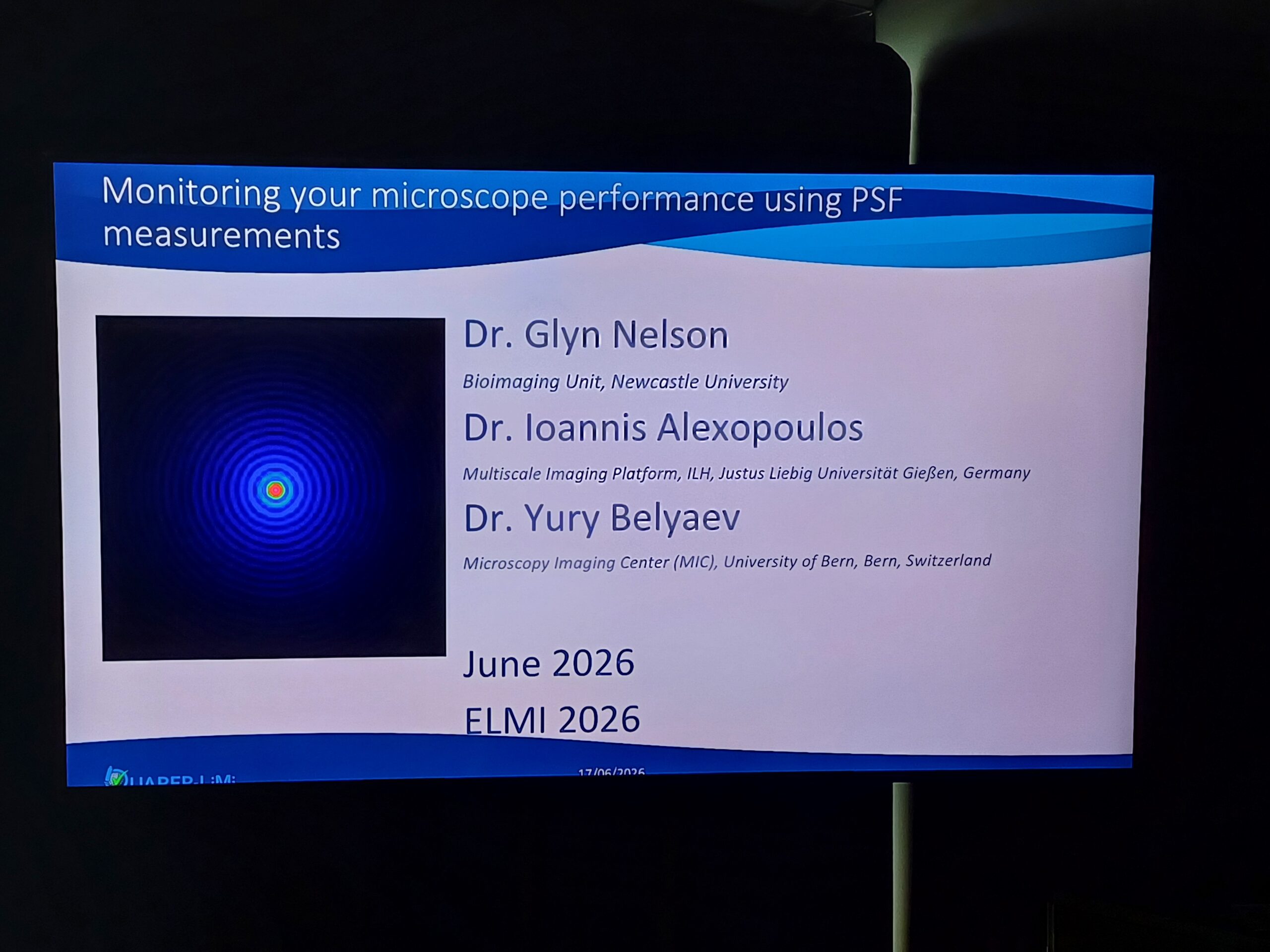


 Glyn Nelson, Ioannis Alexopoulos, Yury Belyaev
The Point Spread Function (PSF), which describes the response of an optical system to a point source, is a key quality control of a microscope. Regular measurements, conducted with consistent tools, methods, and protocols, along with the calculation of robust metrics enable the monitoring of the microscope performance and therefore ensure better reproducibility of scientific experiments. During this workshop, we will show briefly how to prepare a bead slide, how to perform an acquisition, and finally how to analyze the PSF with open-source tools (1, 2). We will give some tips to troubleshooting PSFs that have an abnormal shape or are far from the theoretical expected size. We will also demonstrate the upload of the analysis results to OMERO, a database that will help monitor PSFs over time. We will use the protocols and metrics that are defined in the framework of the QUAREP-LiMi consortium’s WG5 (3).
1. Faklaris O., et al. “Quality Assessment in Light Microscopy for Routine Use through Simple Tools and Robust Metrics.” Journal of Cell Biology 221, no. 11 (2022): e202107093. https://doi.org/10.1083/jcb.202107093.
2. https://github.com/MontpellierRessourcesImagerie/MetroloJ_QC
3. Nelson G., et al. Protocolos.io, Monitoring the point spread function for quality control of confocal microscopes , dx.doi.org/10.17504/protocols.io.bp2l61ww1vqe/v1