
WG 7 – Objectives
Work Group 7 focuses on Image Metadata (initially Microscopy Metadata, but increasingly Experimental, Sample, and Analysis Metadata as well, in line with REMBI recommendations).
Our work spans defining, updating, extending, and maintaining the Light Microscopy Model (published in Nature Methods) of metadata specifications, formalizing Best Practices for the LiMi-Model revision process, building user-friendly tools for metadata capture (such as Micro-Meta App, MethodsJ2 and MDEmic), and integrating captured metadata into cloud-ready storage containers such as the Open Microscopy Environment (OME) Next-Generation File Format (NGFF).
The QUAREP-LiMi Steering Committee has formally endorsed the LiMi-Model, affirming its status as one of the organization’s major outputs. Building on this endorsement, WG7 recently launched the LiMi-Model website, which includes the LiMi-Model Viewer, a user-friendly tool for easily navigating the model.
As an essential part of this work, we are developing and promoting the use of the Next Generation Metadata Framework (NGMF), a LinkML-based, community-driven schema definition language designed to keep metadata interoperable while remaining easy to extend and maintain.
Alongside these efforts, we collaborate with WG 8 – Education, training and outreach, to produce educational material and outreach strategies that promote the adoption of the LiMi-Model and its related tools.
To carry out this work, WG7 organizes into ad-hoc Subgroups (see the “Subgroup” tab below), which are created, paused, or dissolved as needed to accomplish specific goals. Our general meetings serve as a community forum for discussing topics of broad interest, reporting on Subgroup progress, and coordinating strategy across the group.
To get involved, complete the general QUAREP-LiMi membership form, select WG7, and, if you’d like, choose a specific Subgroup (see the “Subgroup” tab below) to work on.
Still not sure where to start? Join one of our upcoming working group meetings — we’re happy to help you find the right fit.
WG 7 – Meetings
On the 3rd Monday of every other month at 5-6:30 pm UTC +1.
Last meeting: 9th March 2026, 5:00 pm
For more details, check the QUAREP-LiMi Calendar.
WG 7 – Co-Chairs




WG 7 - Latest News
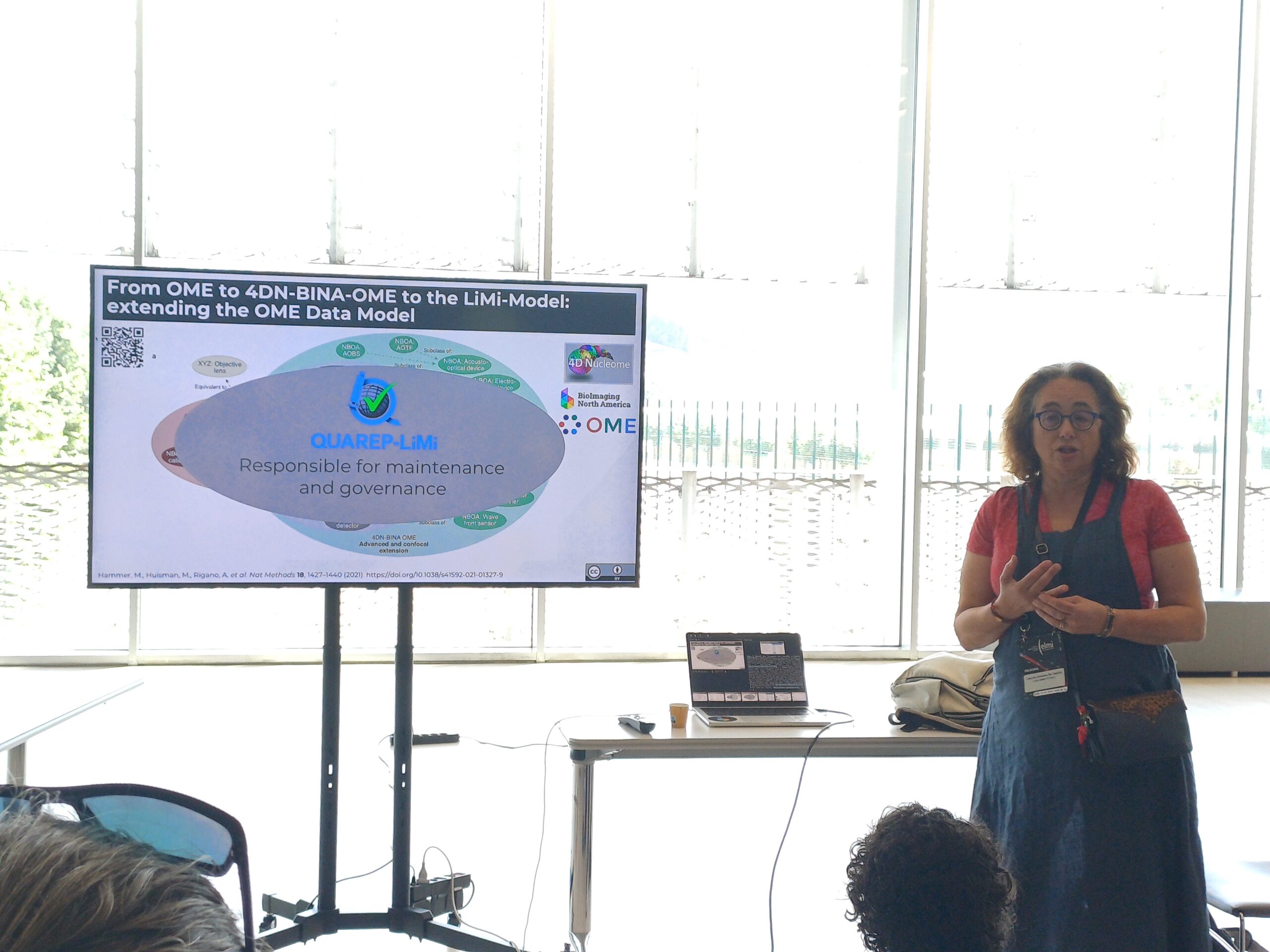

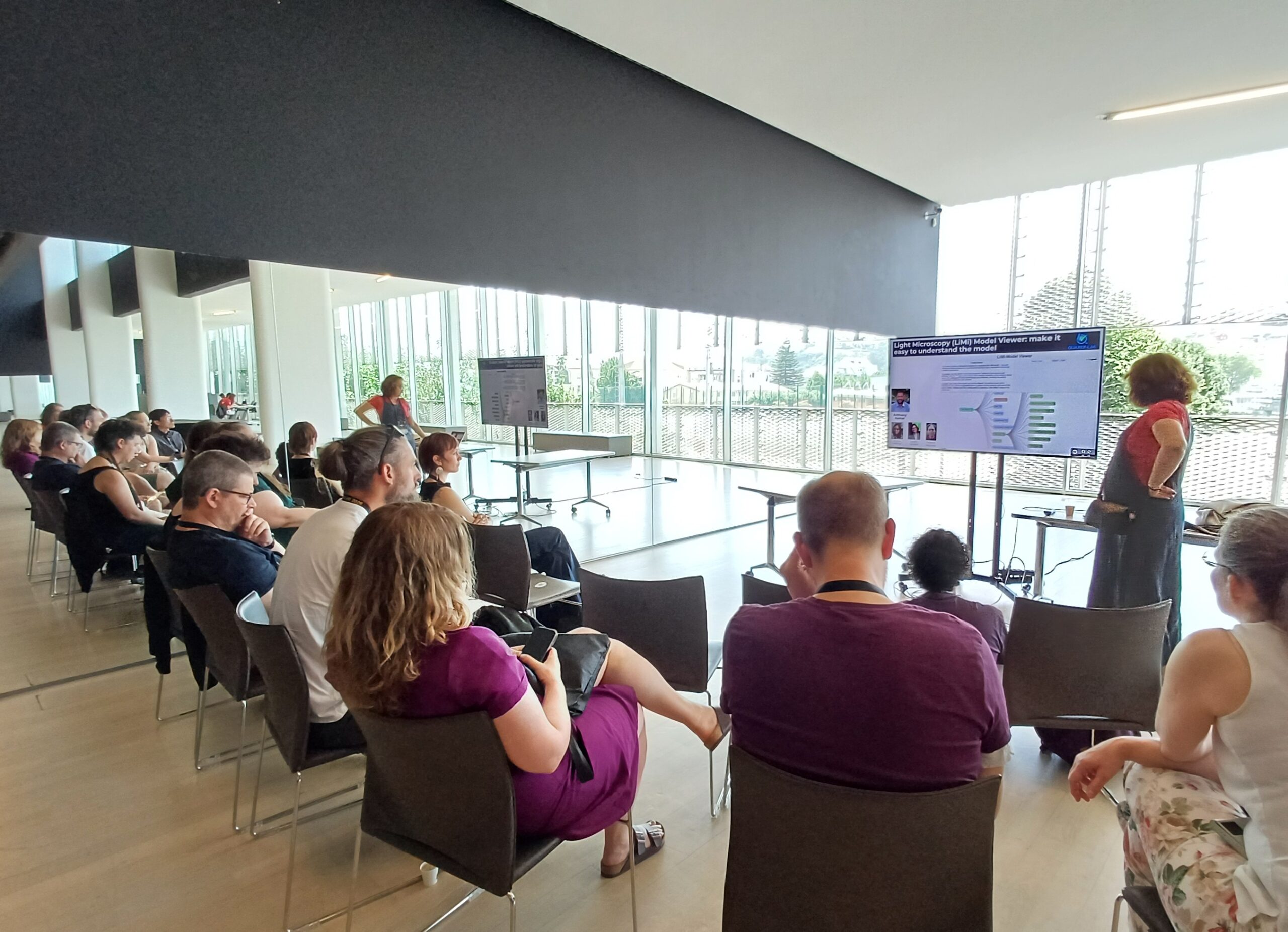

 Caterina Strambio De Castillia
Presenter(s): Caterina Strambio-De-Castillia *1
*- the workshop was presented on behalf of QUAREP-LiMi WG7-Metadata.
1. Program in Molecular Medicine, UMass Chan Medical School
A major output of QUAREP-LiMi is the Light-Microscopy Metadata Model (LiMi-Model) [1, 2], developed by the QUAREP-LiMi Metadata Working Group (WG7) in collaboration with BioImaging North America, the 4D Nucleome consortium and OME. The LiMi-Model was designed to harmonize the description of light microscopy hardware, acquisition settings, and quality-control metrics in order to enhance image quality and reproducibility, and to fulfill the FAIR (Findable, Accessible, Interoperable, and Reusable) data principles.
Specifically, the LiMi-Model aims to: (1) promote the harmonized generation and pre-publication management of image datasets that are FAIR by design; (2) facilitate the deposition of FAIR microscopy datasets to public image data repositories; (3) facilitate data reuse and the extraction of quantitative information from image data using advanced bioimage analysis techniques, including AI/ML; and (4) define the light microscopy implementation of the Image Acquisition module of the Recommended Metadata for Biological Images (REMBI) guidelines [3].
The workshop will open with a general introduction to the purpose and scope of the LiMi-Model, situating it within the broader landscape of community initiatives. These include the recently published minimal reporting recommendations for light microscopy [4], REMBI, the International Standards Organization, imaging modality ontologies (such as FBbi and EDAM-bioimaging), and an emerging vision for next-generation metadata schema definition languages. This will be followed by a presentation of the LiMi-Model website [1] and interactive LiMi-Model Viewer, a tool designed to help community members navigate and understand the content of the model. The workshop will conclude with an overview of the LiMi-Model’s governance structure and an explanation of how community members can engage with and contribute to its ongoing development. As a concrete example of this process, the workshop will introduce the recent Camera Module revision, conducted in partnership with camera manufacturers whose outcomes will also be presented in a related poster presented in collaboration with QUAREP-WG2.
The formal presentations will be followed by an open discussion in which attendees are encouraged to provide feedback and help shape the future direction of the LiMi-Model.
[1] https://quarep.org/working-groups/wg-7-metadata/limi-model
[2] https://doi.org/10.1038/s41592-021-01327-9
[3] https://doi.org/10.1038/s41592-021-01166-8
[4] https://doi.org/10.1083/jcb.202601032
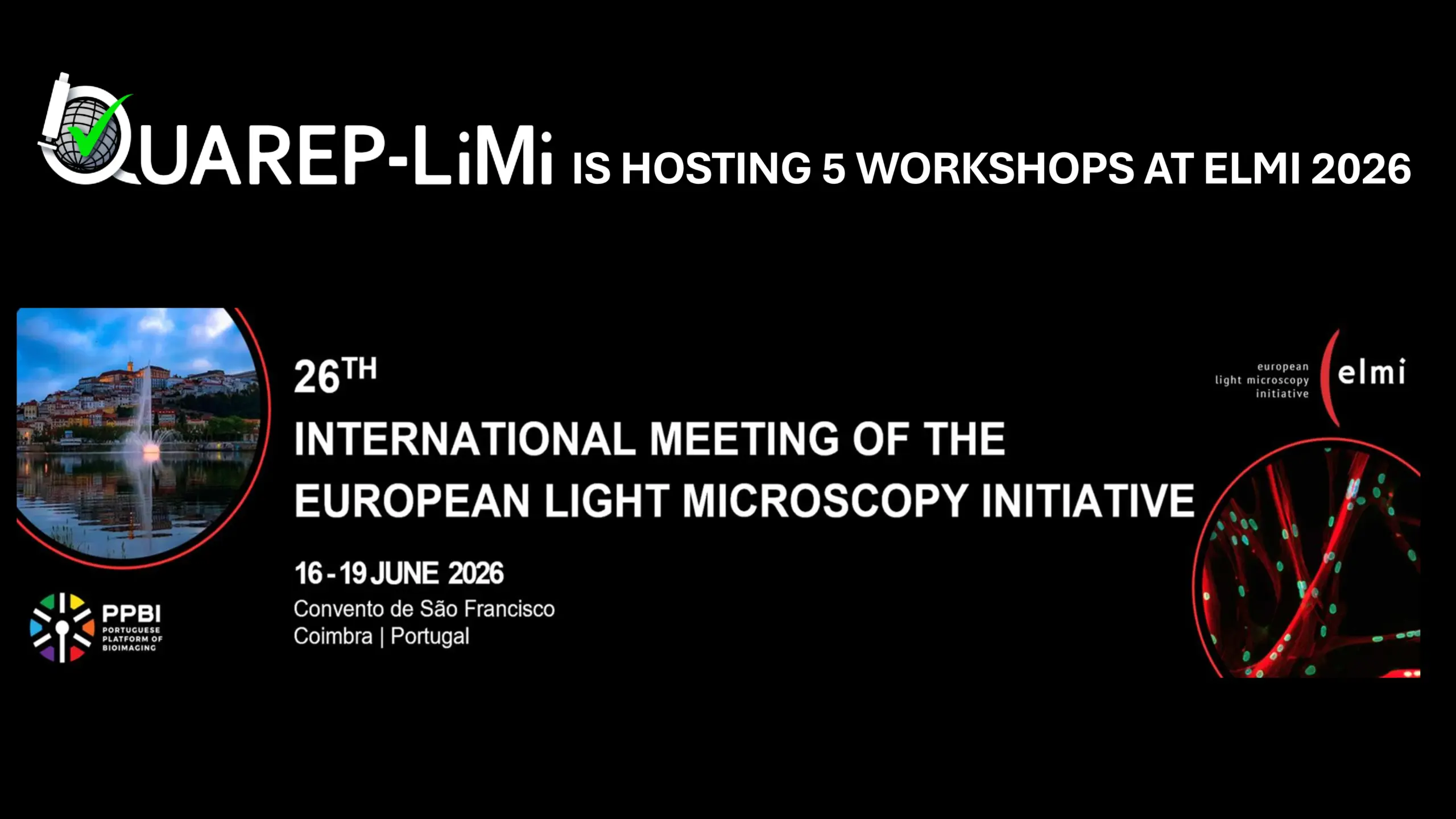
We are pleased to announce that the QUAREP-LiMi consortium will be presenting five specialized workshops at the upcoming European Light Microscopy Institute (ELMI) meeting. Our sessions are designed to provide researchers with frameworks for improving image quality, ensuring data reproducibility, and implementing rigorous quality control standards in microscopy. The workshops will cover five critical pillars of instrument characterization:
-
The QUAREP-LiMi Tool Kit (WGs 1 & 2):
Discover how to streamline periodic quality assessments. We will present the latest developments in the Tool Kit, including user-friendly software tools for illumination power and stability (compatible with Nikon and Zeiss), as well as its data browser for long-term performance monitoring. -
Detector Performance & Photon Characterization (WG2):
Learn how to transition from "arbitrary digital units" (ADU) to actual photon counts using the Photon Transfer Curve (PTC) method. We will demonstrate protocols for characterizing photon conversion factors, read noise, and dynamic range for both point and area detectors. -
Assessing the co-registration accuracy of a microscope (WG4):
Chromatic aberration is a major source of spatial error in multi‑colour fluorescence microscopy. This workshop will show practical hints and tips to perform routine co‑registration measurement and analysis. -
Point Spread Function (PSF) Analysis (WG5):
This workshop provides a practical guide to PSF measurement—from beads slide preparation and image acquisition to analysis using open-source tools and integration with OMERO for longitudinal monitoring. -
The Light-Microscopy Metadata Model (LiMi-Model, WG7):
In collaboration with BioImaging North America, 4D Nucleome, and OME, we will introduce the LiMi-Model. This framework aims to harmonize the description of hardware and acquisition settings to ensure datasets are FAIR (Findable, Accessible, Interoperable, and Reusable) by design.

We warmly welcome our first member from Nigeria, Dr Olubunmi Ayobami Balogun, from the University of Ibadan who just joined Working Group 1, 4 and 12.
Last meeting: 9th March 2026, 5:00 pm
Global Bioimaging Training Module: Reporting and Reproducibility in Microscopy.
- Reporting and Reproducibility in Microscopy modules are dedicated to image metadata, an essential additional information including dimensions, pixel size, image type, bit depth, and microscope settings, all necessary for extraction of meaningful data from images, quantitative image analysis, and reproducibility of experiments. The training module can be found here.
Protocols.io: Getting started with Micro-Meta App Tutorial
- The tutorial can be found here.
Light Microscopy Model (LiMi-Model) of metadata specifications (formerly known as 4DN–BINA-OME):
- Hammer, Mathias, Maximiliaan Huisman, Alessandro Rigano, Ulrike Boehm, James J. Chambers, Nathalie Gaudreault, Alison J. North, et al. “Towards Community-Driven Metadata Standards for Light Microscopy: Tiered Specifications Extending the OME Model.” Nature Methods, December 3, 2021, 1–14. https://doi.org/10.1038/s41592-021-01327-9. CITE
- Huisman, Maximiliaan, et al. “A perspective on Microscopy Metadata: data provenance and quality control.” arXiv, 24 Oct. 2019, arxiv.org/abs/1910.11370v6.
- Explore with the LiMi-Model Viewer
- GitHub
- Provide feedback (How to)
Micro-Meta-App
- Rigano, Alessandro, Shannon Ehmsen, Serkan Utku Öztürk, Joel Ryan, Alexander Balashov, Mathias Hammer, Koray Kirli, et al. “Micro-Meta App: An Interactive Tool for Collecting Microscopy Metadata Based on Community Specifications.” Nature Methods, December 3, 2021, 1–7. https://doi.org/10.1038/s41592-021-01315-z. CITE
- Download
- How to
- Provide feedback
MethodsJ2
- Ryan, Joel, Thomas Pengo, Alex Rigano, Paula Montero Llopis, Michelle S. Itano, Lisa A. Cameron, Guillermo Marqués, Caterina Strambio-De-Castillia, Mark A. Sanders, and Claire M. Brown. “MethodsJ2: A Software Tool to Capture Metadata and Generate Comprehensive Microscopy Methods Text.” Nature Methods, October 15, 2021, 1–3. https://doi.org/10.1038/s41592-021-01290-5. CITE
- Download
- How to
MDEmic (OMERO.mde implementation)
- Kunis, Susanne, Sebastian Hänsch, Christian Schmidt, Frances Wong, Caterina Strambio-De-Castillia, and Stefanie Weidtkamp-Peters. “MDEmic: A Metadata Annotation Tool to Facilitate Management of FAIR Image Data in the Bioimaging Community.” Nature Methods, October 11, 2021, 1–2. https://doi.org/10.1038/s41592-021-01288-z. CITE
- Download
- How to
- GitHub
ACTIVE
- Subgroup 4: Metadata model revision
- Status: ACTIVE
- Aims: Revise the published version of the LiMi-Model of metadata specifications on the basis of feedback from commercial manufacturers and the imaging community.
- Lead: Caterina Strambio De Castillia
- Contact information: caterina.strambio@umassmed.edu
- Ongoing tasks:
- Implement changes requested for the Detector/Camera model collected during a series of meetings held in Spring 2022 with Camera manufacturers and organized jointly by WG2 and WG7
- Changing the overall structure and content of the LiMi-Model Calibration and Performance extension.
- Cloud storage location (can be accessed as a member) → here
SUSPENDED
- Subgroup 1: Improving the usability of Metadata tools
- Status: SUSPENDED UNTIL FURTHER NOTICE
- Aims: Develop user-friendly tools to input, update, and visualize image metadata.
- Co-leads: Caterina Strambio De Castillia and Roland Nitschke
- Contact information: caterina.strambio@umassmed.edu
- Ongoing tasks:
- Provide feedback for the design and usability of Micro-Meta App canvases for capturing Laser Scanning Confocal (LSM) and for Spinning Disk Confocal (SDC)
- Cloud storage archive(can be accessed as a member) → here
- Subgroup 2: Metadata education and outreach
- MERGED WITH QUAREP-LIMI WG 8 – Education, training, and outreach WG
- Cloud storage archive (can be accessed as a member) → here
- Subgroup 3: Metadata storage specifications
- Status: SUSPENDED UNTIL FURTHER NOTICE
- Aims: Develop ways and options (e.g., OMERO) to store/manage/retrieve metadata together with image data and, in particular, OME-NGFF
- Co-leads: Guillaume Gay, Ken Ho, and Damir Sudar
- Contact information: dsudar@qitissue.comandkenneth.ho@crick.ac.uk
- Ongoing tasks:
- Cloud storage archive (can be accessed as a member) → here
To join one or more of the groups, you first need to fill in the general QUAREP-LiMi membership form, select WG7, and then, if desired, pick one of the Subgroups.

40th meeting, 9th of March 2026
Meeting date
Meeting summary
39th meeting, 19th of January 2026
Meeting date
Meeting summary
38th meeting, 17th of November 2025
Meeting date
Meeting summary
37th meeting, 15th of September 2025
Meeting date
Meeting summary
36h meeting, 16th of June 2025
Meeting date
Meeting summary
35th meeting, 5th of May 2025
Meeting date
Meeting summary
33rd meeting, 17th of February 2025
Meeting date
Meeting summary
Memberlist WG 7
Last name First Name Town Organisation Affiliation Lab Affiliation Country Time Zone
Acton
Richard
Cambridge
Human Developmental Biology Initiative
Univ.
GB
UTC+-0
Aleksandrova
Nataliia
Freiburg im Breisgau
UNI Freiburg
Univ.
DE
UTC+1
Alshafie
Walaa
Ashburn
Janelia research campus
Univ.
US
UTC-4
Asmar
Anthony
Gaithersburg
National Institute of Standards and Technology
Gov.
US
UTC-4
Bagley
Steve
Manchester
University of Manch.
Univ.
GB
UTC+1
Bain
Virginia
Danvers
Cell Signaling Technology
Industry
US
UTC-5
Banerjee
Priyam
New York
Rockefeller University
Univ.
US
UTC-5
Bassi
Andrea
Milano
Politecnico di Milano
Univ.
IT
UTC+2
Beavers
Nick
Rockville
Media Cybernetics
Industry
US
UTC-4
Beckert
Hannes
Bonn
GerBi-GMB WG 1
Univ.
DE
UTC+2
Belyaev
Ivan
Jena
Friedrich Schiller University Jena
Univ.
DE
UTC+2
Benton
Matthew
Heidelberg
EMBL
EU-Org
DE
UTC+1
Biehlmaier
Oliver
Basel
Imaging Core Facility, Biozentrum, Basel
Univ.
CH
UTC+1
Blazikova
Michaela
Prague
Light Microscopy Core Facility, IMG CAS
Univ.
CZ
UTC+1
Boehm
Ulrike
Oberkochen
Carl Zeiss AG
Industry
DE
UTC-4
Bourg
Nicolas
Cachan
Abbelight
Industry
FR
UTC+1
Bourn
Matthew
Leeds
National Measurement Laboratory
Industry
GB
UTC+1
Breitlow
Juergen
Berlin
PicoQuant GmbH
Industry
DE
UTC+1
Budde-Sagert
Kai
Rostock
University of Rostock
Univ.
DE
UTC+2
Capek
Martin
Prague
Institute of Molecular Genetics of the Czech Academy of Sciences
Gov.
CZ
UTC+1
Carvalho
Mariana
Braga
INL – International Iberian Nanotechnology Laboratory
EU-Org
PT
UTC+-0
Casas-Moreno
Xavier
Solna
KTH Royal Institute of Technology
Univ.
SE
UTC+1
Cebecauer
Marek
Prague
J. Heyrovsky Institute of Physical Chemistry
Gov.
CZ
UTC+1
Chacko
Jenu
Madison
University of Wisconsin-Madison
Univ.
US
UTC-6
Chen
Lily
Hayward
Eikon Therapeutics
Industry
US
UTC-8
Chinnaraj
Subash Bommu
Amstelveen
Nikon Europe B.V.
Industry
NL
UTC+1
Christopher
Jana
Heidelberg
FEBS Press/Uni Heidelberg/Image-Integrity
Univ.
DE
UTC+1
Cimini
Beth
Cambridge
Broad Institute
Univ.
US
UTC-4
Cole
Louise
Sydney
University of Technology
Univ.
AU
UTC+11
Conde-Sousa
Eduardo
Porto
INEB/i3S
Univ.
PT
UTC+0
Condon
Nicholas
Brisbane
University of Queensland
Univ.
AU
UTC+10
Consani
Angela
Olathe
Bioscience Core Skills Institute
Private lab
US
UTC-6
Contremoulins
Vincent
Paris
CNRS
Univ.
FR
UTC+2
De Niz
Mariana
Chicago
Northwestern University
Univ.
US
UTC-5
Dhmine
Oumou
Monpellier
CNRS
Gov.
FR
UTC+1
Diez-Guerra
F. Javier
Madrid
CBMSO (CSIC-UAM)
Univ.
ES
UTC+2
Dobbie
Ian
Baltimore
Johns Hopkins University
Univ.
US
UTC+5
Duong
Cao Nguyen
Saarbrücken
Leibniz Institute for New Materials
Leibniz
DE
UTC+1
Ecker
Rupert
Vienna
TissueGnostics GmbH
Univ.
AT
UTC+1
Ertugrul
Efe
Montreal
McGill University
Univ.
CA
UTC-4
Eseola
Alice
Norwich
The Sainsbury Laboratory
Univ.
GB
UTC+1
Esner
Milan
Brno
Ceitec Masaryk University
Univ.
CZ
UTC+1
Fazeli
Elnaz
Helsinki
University of Turku / University of Helsinki
Univ.
FI
UTC+1
Gaudreault
Nathalie
Seattle
Allen Institute
Private lab
US
UTC-7
Gauthier
Pascal
Jonquiere
RioTinto
Private lab
CA
UTC+5
Gay
Guillaume
Marseille
France BioImaging, BioCampus, Université de Montpellier
Univ.
FR
UTC+1
Geoghegan
Niall
Coburg North
WEHI
Univ.
AU
UTC+11
Gewerth
Jacob
Roseville
Maka Solutions LLC
Industry
US
UTC-7
Giakoumakis
Nikolaos
Barcelona
Institute for Research in Biomedicine Barcelona
Univ.
ES
UTC+1
Giang
William
Hershey
Penn State University
Univ.
US
UTC-4
Goda
Kazuhito
Hachioji
EVIDENT
Industry
JP
UTC+9
Goutte-Gattat
Damien
London
German BioImaging e.V.
Univ.
GB
UTC+-0
Grebnev
Gleb
Heidelberg
Global BioImaging
Gov.
DE
UTC+1
Griffing
Lawrence
College Station
Texas A&M University
Univ.
US
UTC-5
Grunwald
David
Worcester
University of Massachusetts
Univ.
US
UTC-4
Guaimas
Francisco
San Martin
CONICET-UNSAM
Gov.
AR
UTC-3
Guerrero
Adan
Cuernavaca
National Autonomous University of Mexico
Univ.
MX
UTC+6
Guilbert
Thomas
Cesson-Sévigné
INSCOPER
Industry
FR
UTC+2
Halavatyi
Aliaksandr
Heidelberg
EMBL Heidelberg
EU-Org
DE
UTC+2
Hammer
Mathias
Worcester
University of Massachusetts Medical School
Univ.
US
UTC+5
Hannan
Riley
Charlottesville
University of Virginia
Univ.
US
UTC-5
Hanne
Janina
Konstanz
German BioImaging – Gesellschaft für Mikroskopie und Bildanalyse e.V.
Univ.
DE
UTC+2
Hartley
Matthew
Cambridge
EMBL-EBI
EU-Org
GB
UTC+1
Hatto
Mao
Prague
Nikon
Industry
CZ
UTC+2
Hirsch
Michael
Swindon
UKRI – STFC
Gov.
GB
UTC+-0
Ho
Kenneth
London
The Francis Crick Institute
Private lab
GB
UTC+-0
Holland
Ian
Ottawa
Teledyne Lumenera
Industry
CA
UTC-8
Hu
Jianjiang
Huddinge
Karolinska Institutet
Univ.
SE
UTC+1
Huisken
Jan
Göttingen
Georg-August-Universität Göttingen
Univ.
DE
UTC+1
Ibarra
Humberto
New York
Zuckerman Institute – University of Columbia
Univ.
US
UTC-4
Kadhim
Ahmed
Baghdad
University of Technology-Iraq
Univ.
IQ
UTC+3
Kaiping
Arnica
Freiburg
University of Freiburg
Univ.
DE
UTC+2
Kalaš
Matúš
Bergen
University of Bergen
Univ.
NO
UTC+1
Kemmer
Isabel
Heidelberg
Euro-BioImaging ERIC
EU-Org
DE
UTC+1
Kirchenbüchler
David
Chicago
Northwestern
Univ.
US
UTC-6
Kobayashi
Norio
Wako
Riken
Private lab
JP
UTC+9
Kothari
Maadhav
Cambridge
Project Voxel
Industry
GB
UTC+-0
Kunis
Susanne
Osnabrueck
GerBi-GMB WG 6
Univ.
DE
UTC+2
Kupcu Yoldas
Aybuke
Hinxton
EMBL-EBI
EU-Org
GB
UTC+-0
Kyoda
Koji
Kobe
RIKEN Center for Biosystems Dynamics Research
Gov.
JP
UTC+9
Lacoste
Judith
Montreal
MIA Cellavie Inc.
Industry
CA
UTC-4
Laferriere
Pascal
Nepean
Teledyne Lumenera
Industry
CA
UTC-5
Lai
Pok Yui
Oxford
University of Oxford
Univ.
GB
UTC+1
Lai
Queenie
London
The Institute of Cancer Research
Univ.
GB
UTC+-0
Laktiushkin
Viktor
Sochi
Sirius
Univ.
RU
UTC+3
Landua
Kalika
Houston
Nikon Instruments
Industry
US
UTC-5
Laude
Alex
Newcastle
Newcastle University
Univ.
GB
UTC+1
Le Dévédec
Sylvia Emmanuelle
Leiden
Leiden University
Gov.
NL
UTC-2
Lee
James
Houston
Baylor College of Medicine
Univ.
US
UTC-6
Lee
Kitty
Stanford
Stanford University
Univ.
US
UTC-8
Lerksuthirat
Tassanee
Rachathewi
Mahidol Unive
Univ.
TH
UTC+7
Levitt
James
London
Nikon Imaging Centre, King’s College London, UK
Univ.
GB
UTC+-0
Li
Xiaoming
Shanghaitech
Shanghaitech University
Univ.
CN
UTC+8
Liu
Tristan
New York
Columbia University
Univ.
US
UTC-4
Lopes
Alexandre
Oeiras
IGC
Private lab
PT
UTC+-0
Louis
Boris
Leuven
KU Leuven
Univ.
BE
UTC+1
Ludl
Adriaan-Alexander
Bergen
University of Bergen and ELIXIR Norway
Univ.
NO
UTC+1
Ma
Xiaoxiao
Singapore
A*STAR Mic.Platform
Gov.
SG
UTC+8
Madi
Mehdi
Cachan
Abbelight
Industry
FR
UTC+1
Marcello
Marco
Liverpool
University of Liverpool
Univ.
GB
UTC+1
Martin
Claire
College Station
StraboSpot
Univ.
US
UTC-5
Mast
Fred
Seattle
Seattle Children’s Hospital
Univ.
US
UTC+8
Mateos Langerak
Julio
Montpellier
MRI
Univ.
FR
UTC+2
Mathur
Aastha
Heidelberg
Euro-BioImaging
EU-Org
DE
UTC+2
Matthews
Cedric
Marseille
University of Aix-Marseille
Univ.
FR
UTC+2
McMillan
Paul
Parkville
University of Melbourne
Univ.
AU
UTC+10
Mezzano
Valeria
New York
NYU School of Medicine
Univ.
US
UTC-5
Micu
Ileana
Belfast
Queen’s University Belfast
Univ.
GB
UTC+1
Mikulski
Zbigniew
La Jolla
La Jolla Institute for Immunology
Private lab
US
UTC-8
Mohindra
Rachit
Tucson
Teledyne Photometrics
Industry
US
UTC-7
Moore
Josh
Dundee
University of Dundee
Univ.
GB
UTC+1
Nechyporuk-Zloy
Volodymyr
London
Imperial College of Science, Technology and Medicine
Univ.
GB
UTC+-0
Nemeth
Rita
Barcelona
CRG
EU-Org
ES
UTC+1
Neumann
Sophie
Jena
FSU Jena
Univ.
DE
UTC+2
Nitschke
Roland
Freiburg
University of Freiburg, Life Imaging Center
Univ.
DE
UTC+2
norlin
nils
Lund
Lund University
Univ.
SE
UTC+1
ODonnell
Rob
New York
Rockefeller University Press
Univ.
US
UTC-4
Ogg
Stephen
Thuwal
King Abdullah University of Sccience & Technology
Univ.
SA
UTC+3
Olifirov
Borys
Kyiv
Bogomoletz Institute of Physiology of NAS of Ukraine
Gov.
UA
UTC+2
Onami
Shuichi
Kobe
Riken
Private lab
JP
UTC+9
Oord
Kees
Amsterdam
Nikon
Industry
NL
UTC+1
Pattison
Allister
Belfast
Andor
Industry
GB
UTC+-0
Pengo
Thomas
Minneapolis
University of Minnesota
Univ.
US
UTC-6
Pepperkok
Rainer
Heidelberg
EMBL Heidelberg
EU-Org
DE
UTC+-0
Peron-Cane
Caroline
PARIS
TELIGHT
Industry
FR
UTC+1
Petitto
Jocelyn
Brimfield
UMassChan
Univ.
US
UTC-4
Piguet
Joachim
Stockholm
KTH Royal Institute of Technology
Univ.
SE
UTC+1
Pimentel
Arturo
Mexico
Biotechnology Inst.
Univ.
MX
UTC-5
Podder
Santosh
Pune
IISER Pune
Gov.
IN
UTC-8
Pospíšil
Jakub
Dresden
QUAREP-LiMi / Technische Universität Dresden
Univ.
DE
UTC+1
Price
Meridith
Chapel Hill
Oxford Inst. Bitplane
Industry
US
UTC-4
Rad
Dorsa
Sydney
ANZAC Research Instittue
Univ.
AU
UTC+11
Relich
Peter
Torrance
Intellisense Systems, Inc.
Univ.
US
UTC-7
Reymann
Jürgen
Mannheim
Leica
Industry
DE
UTC+2
Rhode
Sebastian
Munich
Carl Zeiss Microscopy GmbH
Industry
DE
UTC+2
Rigano
Alessandro
Worcester
UMass Chan Medical School
Univ.
US
UTC-5
Rogers
Kelly
Parkville
Walter & Eliza Hall Institute of Medical Research
Univ.
AU
UTC+10
Rosa Molinar
Eduardo
Saint Louis
Washington University in Saint Louis School of Medicine
Univ.
US
UTC+6
S. Teófilo
Francisco
Campinas
University of Campinas
Univ.
BR
UTC-3
Saeed
Mezida
Edgabaston
University of Birmingham
Univ.
GB
UTC+-0
Saint-Hilaire
Cadisha
Paris
Curie Institute
Univ.
FR
UTC+1
Sanders
Mark
Minneapolis
University of Minnesota
Univ.
US
UTC-5
Sanguinetti
Bruno
Zug
Dotphoton AG
Industry
CH
UTC+1
Schoonderwoert
Vincent
Hilversum
Scientific Volume Imaging BV
Industry
NL
UTC+1
Schreiner
Ryan
New York
Weill Cornell Medicine
Univ.
US
UTC-4
Schroth-Diez
Britta
Dresden
MPI-CBG
MPG
DE
UTC+2
Schuster
Aminul
London
N/A
Univ.
GB
UTC+-0
Scott
Ryan
Moffett Field
KBR/NASA Ames
Gov.
US
UTC-8
Selchow
Olaf
Gera
Microscopy & BioImaging Consulting
Industry
DE
UTC+2
Shakouri
Mahsa
Heidelberg
DKFZ
Industry
DE
UTC+12
Sharma
Riya
Stamford
University of Massachusetts Chan Medical Center
Univ.
US
UTC-5
Sherwood
Francois
Hinxton
EMBL-EBI
EU-Org
GB
UTC+-0
Sibbons
Jane
Adelaide
University of Adelaide
Univ.
AU
UTC+9
Silván Alcaraz
Ágata
Copenhagen
University of Copenhagen
Univ.
DK
UTC+1
Sisamakis
Evangelos
Berlin
PicoQuant GmbH
Industry
DE
UTC+1
Sixtová
Nikola
Prague 8
Heyrovsky Institute of Physical Chemistry
Private lab
CZ
UTC+1
Smith
Carlas
Delft
Delft University of technology
Univ.
NL
UTC+2
Srinivasan
Sathya
Beaverton
ONPRC
Univ.
US
UTC-8
Staurovsky
Susan
Farmington
UConn Health
EU-Org
US
UTC-4
Strambio De Castillia
Caterina
Worcester
University of Massachusetts Medical School, Program in Molecular Medicine; Chan Zuckerberg Initiative; BINA Quality Control and Data Management Working Group
Univ.
US
UTC-4
Sudar
Damir
Oakland
Quant.Ima. Systems
Industry
US
UTC-7
Swedlow
Jason
Dundee
University of Dundee
Univ.
GB
UTC+1
Ta
Adam
Seattle
Sage Bionetworks
Private lab
US
UTC+-0
Takahashi
Yuta
Shinagawa-ku
Nikon
Industry
JP
UTC+9
Tapia
Pablo
Bethesda
National Institutes of Health (NIH)
Gov.
US
UTC-4
Tosi
Sebastien
Copenhagen
UCPH / DBI-INFRA
Univ.
DK
UTC+1
Tsuchida
Mark
Madison
University of Wisconsin-Madison
Univ.
US
UTC-6
Tzavaras
Nikos
New York
Icahn School of Medicine at Mount Sinai
Univ.
US
UTC-5
Ulman
Vladimír
Brno
CEITEC, Masarykova Univerzita
Univ.
CZ
UTC+1
Vierdag
Wouter-Michiel
Heidelberg
European Molecular Biology Laboratory
EU-Org
DE
UTC+2
Wagner
Darcy
Montreal
McGill University
Univ.
CA
UTC-4
Wang
Xiaowen
Copenhagen
University of Copenhagen
Univ.
DK
UTC+2
Watson
Kemp
Georgetown, Ontario
Objective Pathology Services Limited
Industry
CA
UTC-4
Wee
Erika
Cold Spring Harbor
Cold Spring Harbor Laboratory
Univ.
US
UTC-5
Weis
Markus
Münster
Olympus Soft Imaging Solutions GmbH
Industry
DE
UTC+1
West
Steven
London
Sainsbury Wellcome Centre, UCL
Univ.
GB
UTC+-0
Wiegraebe
Winfried
Seattle
Bruker
Industry
DE
UTC+8
Wong-Ng
Jerome
Paris
Institut Pasteur
Univ.
FR
UTC+1
Yunling
XU
Paris
Parcc, U970, Inserm
Univ.
FR
UTC+1
Zehrer
Ando
Krailling
Teledyne
Industry
DE
UTC+2
Zulueta-Coarasa
Teresa
Hinxton
EMBL-EBI
EU-Org
GB
UTC+-0